
AI agents are starting to shop. Is your store ready for them?
Adeptra checks 50 signals across UCP, ACP and AI-crawler access — the standards agentic commerce is being built on — and shows you exactly what’s missing. Your first audit is free.
- robots.txt is present and validready
- AI search crawlers are allowed to fetch pagesready
- Sitemap is published and lists pagesready
- Page content is in the HTML, not JavaScriptpartly ready
- Product pages carry Product structured datanot ready
- Store profile file is publishednot ready
Illustration of the check sequence. shop.example.com is a fictional store.
A report your developer can actually ship from
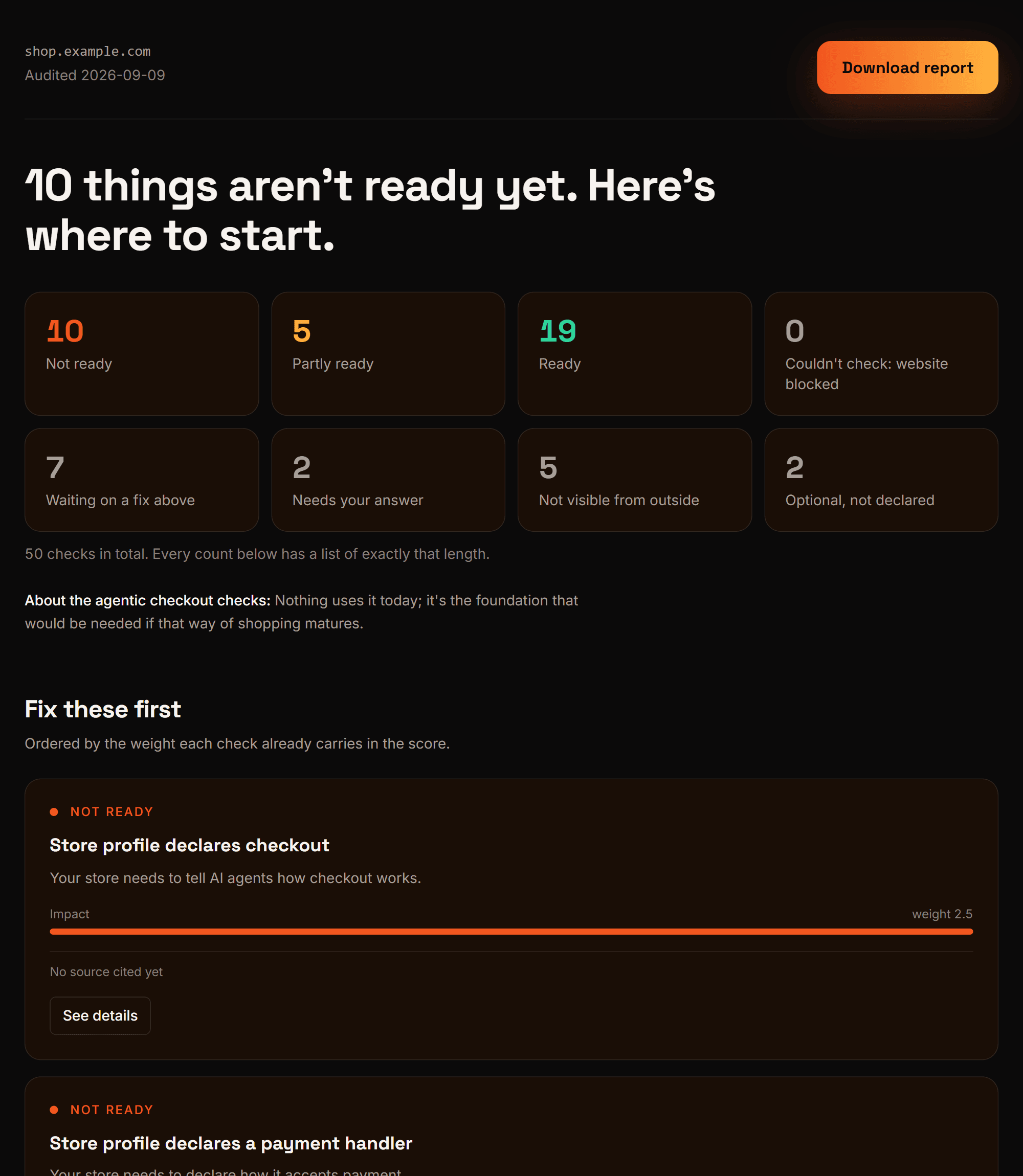
Sample report — not a real store. shop.example.com is fictional and the findings are illustrative. It is produced by the same code that generates a real audit, so the checks, the scoring and the layout are the real thing.
Three groups. Fifty checks. Each one says what it’s based on.
Store profile & product data
What your store publishes about itself and its products.
Agentic checkout readiness
Whether the checkout discovery document is published and complete.
Nothing uses it today; it's the foundation that would be needed if that way of shopping matures.
AI crawler access
Whether an agent can reach and read your pages.
- 5 partly ready
- 10 not ready
- 7 waiting on a fix above
- 2 needs your answer
- 5 not visible from outside
- 2 optional, not declared
A number that reconciles, or no number at all
Every count on your report has a list of exactly that length behind it, and the counts account for every check in scope. Where a check couldn’t run, the report says why rather than dropping it from the total. A score and a count are never merged into one figure.
See how the score is weightedWhere these checks come from
Every check says what it’s based on: a published specification, a platform’s own documentation, or behaviour we measured. Where the evidence is contested, the report says so. Where we haven’t sourced a check yet, it says that too.
- ucp.dev
Universal Commerce Protocol
32 of 50The manifest, the capability declarations, and the product-data rules. Google and Microsoft have each published their own UCP integration guidance.
- agenticcommerce.dev
Agentic Commerce Protocol
8 of 50Maintained by OpenAI, Stripe and Meta. Nothing consumes the merchant-hosted discovery file today — its authors say they are still “working to create discovery mechanisms for AI platforms to identify businesses that have implemented ACP.” We check it as the foundation agentic checkout would need if that model matures.
- developers.openai.com
AI crawler documentation
10 of 50Whether OAI-SearchBot, GPTBot and the other named crawlers can reach and read your pages, per each operator’s own published rules.
- support.google.com
Merchant Center product data
The feed requirements both Google and Microsoft operate against.
- schema.org/Product
schema.org
The structured-data vocabulary the above are built on.
FAQ
What do you actually check?
50 checks in three groups: 32 against the Universal Commerce Protocol — the manifest, your capability declarations, and product-data rules; 8 against the Agentic Commerce Protocol; and 10 on whether AI crawlers can reach and read your pages. Each check states its basis — the specification or platform document it comes from, the behaviour it measures, or that no source is cited yet.
Will this get my products recommended by ChatGPT or Gemini?
No. Whether an assistant recommends a product depends on price, availability and competition — none of which an audit controls. What we check is narrower and verifiable: whether your store is eligible to be read, listed and bought from. Not whether it gets chosen.
Is the audit really free?
Yes. Auditing your store is free, and you can run it again after you make changes. The report is free too, including a short summary of each fix. What you pay for is the fix package: step-by-step instructions and the files your developer implements from.
Do I need to install anything?
No. No plugin, no code change, no access to your store admin. You give us your store’s URL and we check what a crawler would see.
Find out before an agent does.
Your first audit is free, once per account. You see every finding, with its evidence, before you pay for anything.